
This article summarises the practical information that Klára Salabová discusses with customers during every appointment at our Prague 8–Karlín studio – and explains why it makes sense to purchase diamonds from trusted, experienced jewellers.
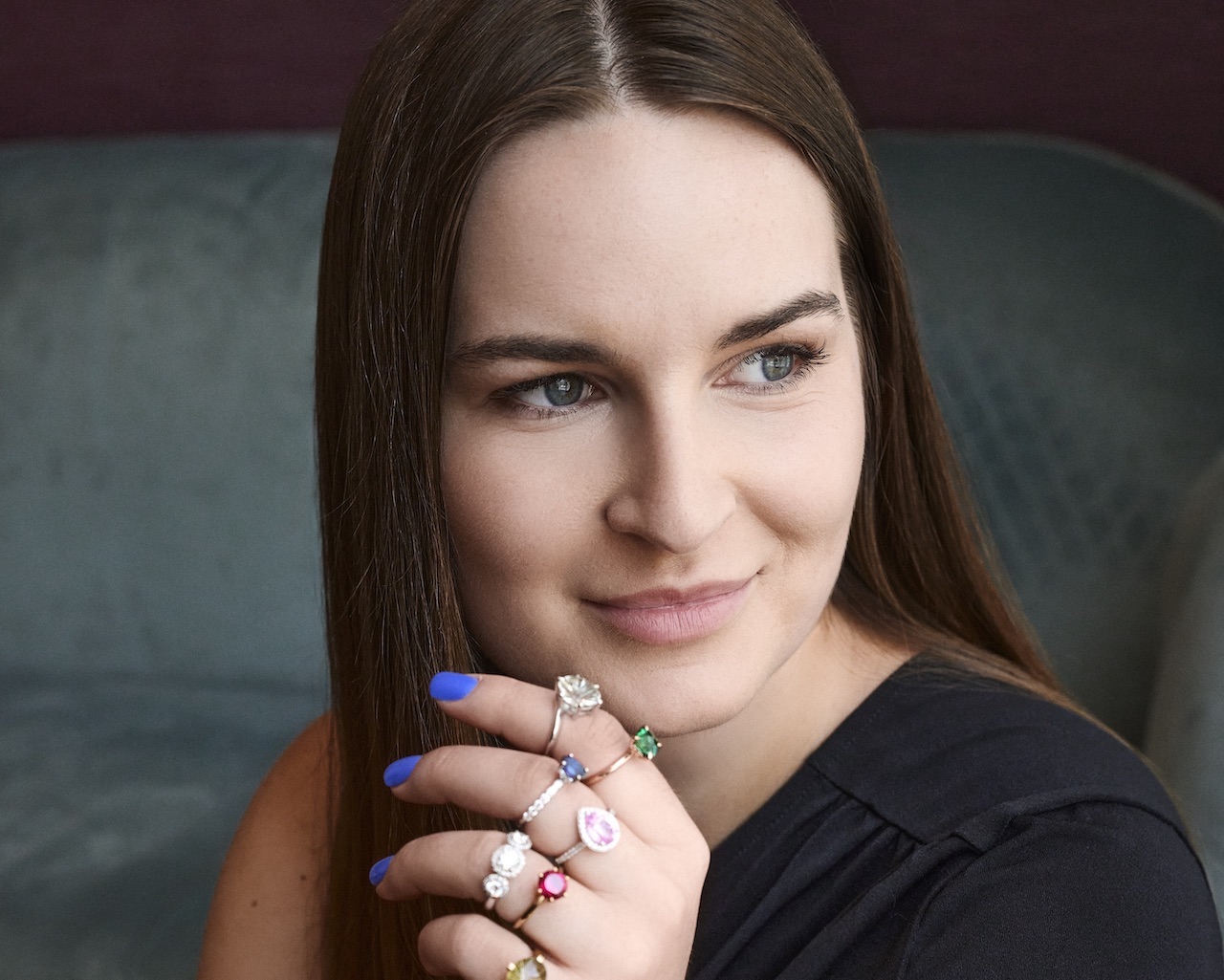
Klára Salabová is one of only seven people in the Czech Republic to have earned the GIA Graduate Diamonds diploma. With us, you can be confident that you are entrusting the selection of your diamond to a genuine expert.
A Certificate Is Not Enough: A Laser Inscription as the Stone’s ‘Identification Number’
For natural and laboratory-grown diamonds weighing more than 0.30 ct, an international certificate – typically from the GIA or IGI – is standard.
A key security feature is the laser inscription: a tiny number engraved by laser on the diamond’s girdle that matches the number on its certificate.


— Klára Salabová
On laboratory-grown stones, the inscription usually also includes the letters LG (Lab Grown) before the number.
Diamond Treatments and the Risks of Buying on Your Own
Klára Salabová highlights a common mistake made by those trying to save money by purchasing a diamond outside a trusted supply chain, for example online. Some diamonds have surface-reaching cracks, known as ‘feathers’, which have subsequently been treated – most commonly by filling them with a glass-like substance in a process called fracture filling – to make them less visible. At first glance, a treated stone may appear to be of better quality than it actually is.
The problem often only becomes apparent when the stone is set in a piece of jewellery. The diamond is weakened at the point of the crack and may become damaged or even fracture under pressure. With treated diamonds, there is also a risk that the filling will not be permanent and may deteriorate over time or become damaged during repairs.
It is therefore important to purchase diamonds only from trusted sources and always with an appropriate certificate that clearly discloses any treatments.

Setting an Inherited Diamond in a Ring: Potential Risks
The idea of giving a family diamond a new lease of life may sound romantic. In reality, however, it can be more complicated. As Klára Salabová points out, older stones – including those that are 70 to 100 years old – may not meet modern cutting standards and can contain more internal imperfections.
Resetting them therefore carries a genuine risk of damage or, in the worst-case scenario, the stone fracturing.

Balancing Clarity, Colour and Metal: A Stone Must Always Be Assessed in the Context of Its Setting
Choosing a diamond involves more than deciding between ‘natural or laboratory-grown’. Of the 4Cs used to assess diamonds, the two parameters we discuss most frequently with customers are clarity and colour. Both must always be considered in relation to the metal in which the stone will be set.
-
White gold / platinum: Even a slight tint will be noticeable. It often makes sense to choose a more colourless stone, even at the expense of perfect clarity. We recommend choosing no lower than SI1 clarity, as SI2 diamonds already contain inclusions that are visible to the naked eye.
-
Yellow gold: The warm reflection of the metal can visually balance the stone’s tint, so you may sometimes be able to compromise on colour and opt for greater clarity instead.
— Klára Salabová
There is one more essential detail: clarity is not merely a matter of appearance. It also affects safety.
Clarity is extremely important. It influences not only the stone’s appearance but also its durability during setting and everyday wear.
How Do Global Events Affect Jewellery Production Times?
The diamond market responds quickly to global events. For express orders, logistics and the route taken by the stone are crucial. Klára Salabová explains that sometimes producing the ring is not the issue – sourcing and delivering a specific stone on time is.
For example, if a customer requests express production within two or three weeks, it is necessary to choose stones whose transport route avoids diamond exchanges in India or Dubai so that the required deadline can be met.
Conclusion: What Should You Actually Check?
To put it simply, if you want to minimise the risk of being misled when purchasing a diamond, focus on three things: its certification, whether the stone matches its certificate through its laser inscription, and the diamond’s 4C characteristics in the context of the chosen metal and setting.
Beauty is immediately visible. Safety and fairness lie in the details.