Natural diamonds are among the most sought-after gemstones in the world. The value of a diamond is determined by the 4Cs: COLOR (diamond color), CLARITY (diamond clarity), CUT (diamond cut), and CARAT (diamond carat weight).
If you encounter the term 5Cs of diamonds, the fifth C refers to the CERTIFICATE. We provide a certificate with every diamond, whether natural or lab-created. You can read more about certificates here.

CUT
The cut refers to the way a diamond has been shaped and polished from its raw state. A quality cut maximizes the diamond's brilliance, fire, and scintillation by optimally capturing and reflecting light. 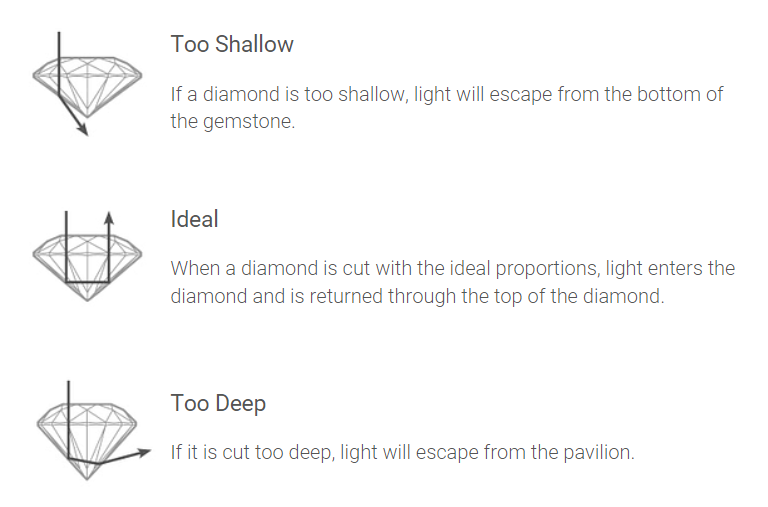
A good cut significantly impacts the overall appearance and value of a diamond. An important aspect is brilliance, which is the diamond's ability to reflect white light from both its surface and its interior.
Brilliance is crucial for the diamond's overall sparkle and shine, enhancing its aesthetic value and appeal.
COLOUR
Another important factor is a diamond’s colour. This criterion assesses the presence of colour in the stone, with the most valuable diamonds displaying the least colour.
Diamonds are graded on a scale from D (colourless) to Z (noticeably coloured).
Colourless diamonds (D–F) are extremely rare and the most valuable because they allow the greatest amount of light to pass through and exhibit the highest brilliance. Diamonds with a faint hint of colour (G–J) are also highly sought after, but their value decreases as the intensity of the colour increases.
Colour grading is carried out at gemmological institutions by manually comparing diamonds with a set of master stones known as a colour reference set. This ensures accurate and consistent results. A diamond’s colour is important because it affects the gemstone’s overall appearance and aesthetic appeal.
CLARITY
This characteristic relates to the presence and visibility of internal and external imperfections known as inclusions and blemishes.
-
Inclusions: Internal imperfections, such as small cracks or foreign material within the diamond.
-
Blemishes: Surface imperfections, such as scratches or irregularities.
Clarity is assessed under 10× magnification and graded according to the following scale:
- Flawless (FL): No imperfections visible under 10× magnification.
- Internally Flawless (IF): No internal imperfections, only minor surface blemishes.
- Very, Very Slightly Included (VVS1, VVS2): Minute inclusions that are extremely difficult to see under 10× magnification.
- Very Slightly Included (VS1, VS2): Very small inclusions visible under 10× magnification.
- Slightly Included (SI1, SI2): Small inclusions that are easily visible under 10× magnification.
- Included (I1, I2, I3): Visible inclusions that may affect the diamond’s transparency and brilliance.

A diamond’s clarity affects its brilliance and overall value. Diamonds with fewer and smaller inclusions and blemishes are rarer and more valuable.
CARAT WEIGHT
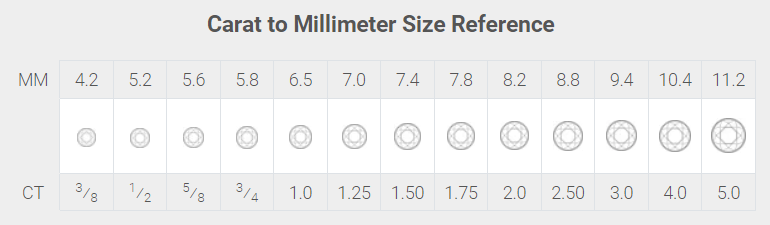
A diamond’s weight is measured in carats, with one carat equal to 200 milligrams. A carat is further divided into 100 points, so a 0.75-carat diamond may also be described as a 75-point diamond.
Larger diamonds are rarer and therefore command a higher value per carat. This means that a diamond’s price rises exponentially with its size. For example, a two-carat diamond is not simply twice as expensive as a one-carat diamond, but often considerably more expensive because of its rarity.
When considering a diamond’s carat weight, it is important to remember that two diamonds of the same weight may have different values depending on the other 4C criteria: cut, colour and clarity.
A diamond’s overall value is determined by the combination of all these parameters.
WHAT IS THE DIFFERENCE BETWEEN THE ABBREVIATIONS CT AND KT?
Ct (carat): Ct is the abbreviation for carat, which is used to measure the weight of diamonds and other gemstones. One carat is equal to 200 milligrams (0.2 grams). This term is commonly used in jewellery to indicate the weight of individual gemstones.
Kt (karat): Kt is the abbreviation for karat, which is used to indicate the purity of gold. In this context, karat measures the fineness of gold, with 24kt (24 karats) representing pure gold. Lower karat values, such as 18kt or 14kt, indicate that the gold has been alloyed with other metals to increase its strength and durability.
In summary:
- Ct (carat) is used to measure the weight of gemstones.
- Kt (karat) is used to measure the purity of gold.